Aluminium AlMg3 (EN AW-5754)
Aluminium with about 3 % magnesium, material number 3.3535. Not heat treatable, so it gets its strength from rolling rather than from ageing, and the magnesium is what keeps it corrosion resistant in weather and in salt water. It anodises well.
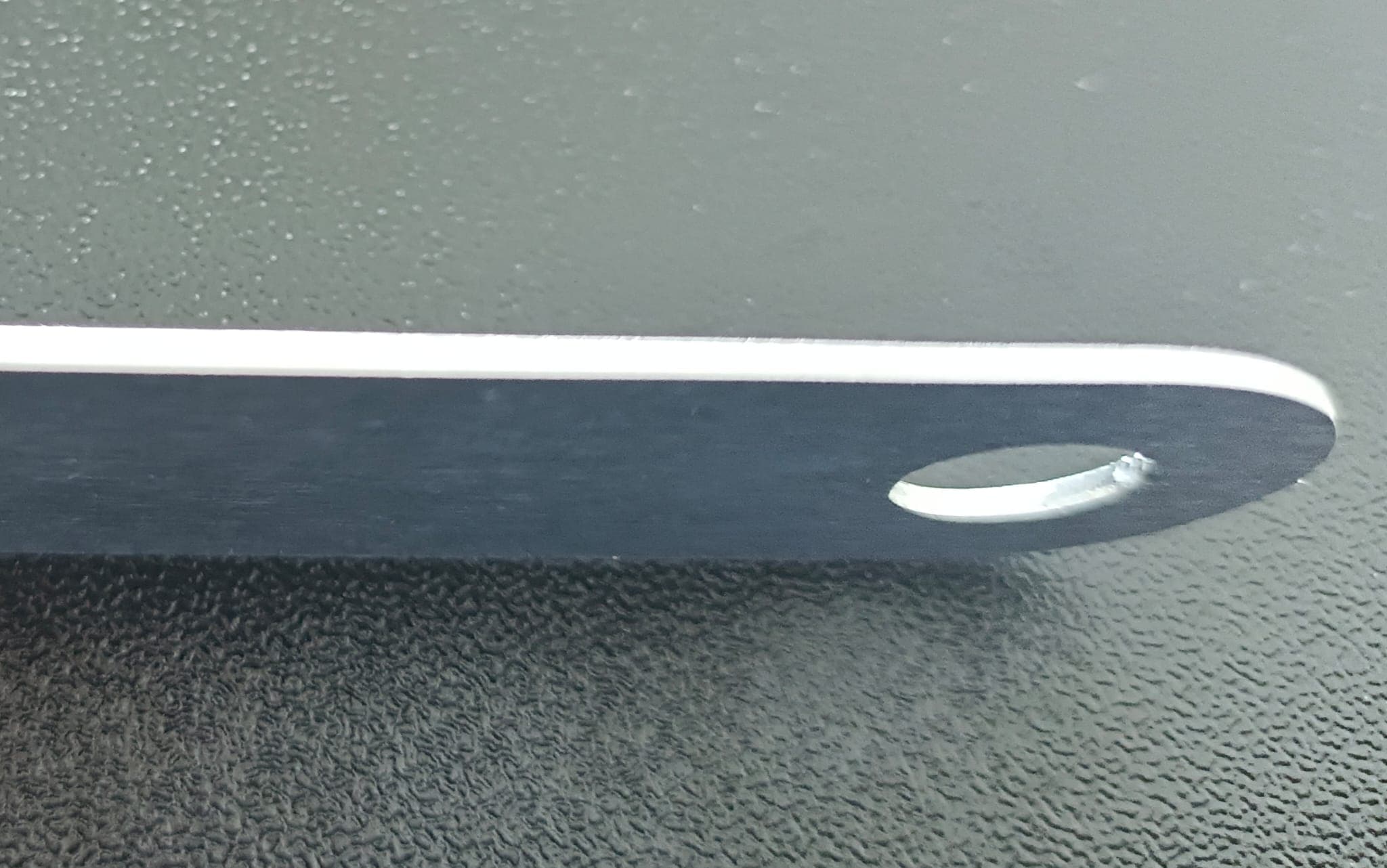
Typical parts: Enclosures, front panels, brackets, mounting plates, and anything that has to be light or live outdoors unpainted.
Technical Properties
| Composition | Al remainder, Mg 2.6 to 3.6, Mn max 0.5, Cr max 0.3, Fe max 0.4, Si max 0.4, Zn max 0.2, Ti max 0.15, Cu max 0.1 (%) |
|---|---|
| Standard | EN 573-3, EN 485-2 |
| Material number | 3.3535 (EN AW-5754) |
| Density | 2.67 g/cm³ |
| Tensile strength Rm | 190 to 250 N/mm² |
| Yield strength Rp0.2 | 80 to 190 N/mm² |
| Elongation at break A50 | 12 to 18 % |
| Hardness | 50 to 75 HBW |
| Elastic modulus E | 70 GPa |
| Thermal conductivity | 130 W/(m·K) |
| Melting range | 600 to 640 °C |
| Heat treatable | No, work hardening only |
| Weldable | Yes, TIG and MIG |
| Magnetic | No |
| Does it rust | No, seawater resistant |
Available thicknesses and manufacturability
| Thickness (mm) | Weight (kg/m²) | Min. Hole Diameter | Min. Bridge Width | Min. Hole-to-Edge |
|---|---|---|---|---|
| 1 mm | 2.67 | 0.5 mm | 0.2 mm | 0.2 mm |
| 1.5 mm | 4.01 | 0.75 mm | 0.3 mm | 0.3 mm |
| 2 mm | 5.34 | 1 mm | 0.4 mm | 0.4 mm |
| 3 mm | 8.01 | 1.5 mm | 0.6 mm | 0.6 mm |
| 4 mm | 10.68 | 2 mm | 0.8 mm | 0.8 mm |
Max Part Size: 550 x 1150 mm · Min. Part Size: 10 x 10 mm
Calculate the weight for your dimensionsWhat a part in Aluminium AlMg3 costs
Example: a mounting plate 100 × 60 mm, 2 × 2 holes (5.5 mm, for M5) in every thickness, computed when this page loads with the configurator's own formula. Price per piece incl. VAT, plus shipping.
| Thickness | 1 pcs | 10 pcs | 100 pcs |
|---|---|---|---|
| 1 mm | €10.61 | €3.67 | €1.95 |
| 1.5 mm | €11.80 | €4.25 | €2.38 |
| 2 mm | €12.91 | €4.89 | €2.89 |
| 3 mm | €14.91 | €6.16 | €3.94 |
| 4 mm | €16.66 | €7.35 | €4.96 |
The configurator prices other sizes, holes and shapes as you type; you pick material and thickness there next to the part. Configure this plate
Parts in Aluminium AlMg3
These parts have a page of their own with prices, limits and the questions people ask most:
- Custom Laser-Cut Metal Sign
- Custom Washers and Shims, Laser Cut
- Custom Gusset Plates, Laser Cut
- Custom Front and Enclosure Panels
- Metal Lettering, Laser Cut to Order
- Custom Mounting Plate with Holes
- Custom Metal Plate, Laser Cut to Size
- Custom Metal Disc, Laser Cut
- Slotted Flat Bar, Laser Cut to Size
- Custom Link Plate, Laser Cut
- Laser-Cut Metal Gear, Made to Size
- Custom Hinge Plate in Metal
Compare materials
Which thickness for which part
You will also find AlMg3 sold as EN AW-5754, 3.3535 or simply aluminium sheet. It weighs only a third of steel, but it is also much softer and flexes more easily. So plan one step thicker than you would in steel:
- Signs, trim panels, nameplates: 1 to 1.5 mm
- Front panels for enclosures: 2 mm, or 3 mm once an edge is longer than about 300 mm
- Mounting plates for electronics and light devices up to about 5 kg: 3 mm
- Brackets that carry something heavy: better in steel. A part that would need 4 mm in aluminium is stiffer and cheaper as 3 mm S355MC.
These are rules of thumb for static loads. If a part carries people or could do damage if it fails, someone should run the numbers.
How the part arrives
The sheet has its mill finish and comes without protective film. Aluminium scratches more easily than steel, so on a part that will be on show, handling marks are more likely than on stainless. For visible parts, anodising is the better choice, and it also makes the surface much harder to scratch.
Aluminium is cut under nitrogen, so the edge is bright and free of oxide and can be anodised or painted without any preparation. Parts up to 2 mm can be handled as they come. At 3 and 4 mm the edge can carry a burr, and deburring is worth it.
Tolerance is ISO 2768-m: a 200 mm front panel is within ±0.5 mm, a hole for a socket up to 6 mm within ±0.1 mm.
Working on it yourself
- Anodising: AlMg3 anodises evenly. We do not anodise in house, but any local anodiser can take the parts as they come from us.
- Threads: Aluminium is soft, and a thread in thin sheet strips quickly. For M3, 2 mm is enough; for M4, plan on 3 mm. For screws that get undone often, a rivet nut or a thread insert holds better.
- Drilling and sawing: Works with ordinary HSS tools. A little methylated spirit as coolant stops the aluminium from sticking to the cutting edge.
- Bending: Up to 2 mm bends by hand in a vice. Protect the jaws with aluminium or wood so they do not mark the surface.
Common mistakes
- Expecting anodising to hide scratches: It does the opposite. Scratches from before anodising remain clearly visible afterwards, so handle parts with care before they go in, or have them brushed first.
- Aluminium bolted straight to steel or stainless outdoors: The aluminium corrodes where the metals touch. A plastic washer in between prevents it.
- A thread in thin sheet for a screw that gets undone often: It strips after a few turns. Use thicker sheet or a rivet nut.
- Aluminium as a bracket under load: It looks solid and still sags over time. If it has to carry anything, steel is the better choice.
Questions and Answers
- When should I use steel instead?
- As soon as it carries load. E is 70 GPa against 210 for steel, so aluminium deflects three times as far at the same section. A 3 mm aluminium bracket that visibly flexes will sit still in 2 mm steel, and cost less.
- Bending and welding?
- Both fine. Bend across the rolling direction where the part allows it. TIG and MIG both work, but reckon on the heat affected zone giving up something like a third of its strength, which matters if the seam is where the load goes.
- What does the cut edge look like?
- Blank, no oxide. Aluminium is cut under nitrogen, so nothing has to come off the edge before anodising or painting.